
By Dara

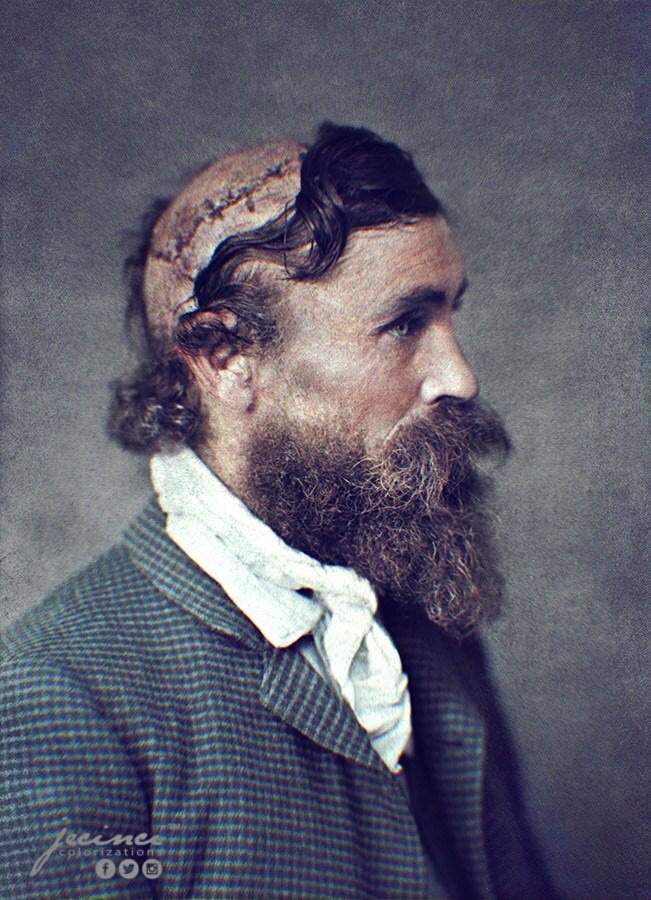
At 13 years old Robert McGee suffered a torturous and traumatic event that few lived to tell about- being scalped.
In the summer of 1864 he set out across the great plains of the American West with his parents. It was a long and grueling journey. Somewhere, before Leavenworth, KS, both of his parents died. The adults of the wagon train helped take care of the orphan boy until they reached Leavenworth, KS. Having no parents and no one willing to take him in, he joined the employ of Mr. H.C. Barret.
Mr. Barret was getting desperate for men to take the long journey to Ft. Union, New Mexico to deliver supplies for the military. The attacks from the Native Americans had reached a fever pitch that summer and many people had lost their lives. Somehow, Mr. Barret convinced young Robert McGee to join his nervous teamsters. The following is an excerpt of Robert’s story as described by Henry Inman in The Old Santa Fe Trail: (Disclaimer: The following is an excerpt; the opinions expressed by the author are not my opinions.)
At that time the Indians of the great plains, especially along the line of the Santa Fe Trail, were very hostile, and continually harassing the freight caravans and stage-coaches of the overland route. Companies of men were enlisting and being mustered into the United States service to go out after the savages, and young Robert McGee volunteered with hundreds of others for the dangerous duty. The government needed men badly, but McGee’s youth militated against him, and he was below the required stature; so he was rejected by the mustering officer.

Mr. Barret, in hunting for teamsters to drive his caravan, came across McGee, who, supposing that he was hiring as a government employee, accepted Mr. Barret’s offer.
By the last day of June the caravan was all ready, and on the morning of the next day, July 1, the wagons rolled out of the fort, escorted by a company of United States troops, from the volunteers referred to.
The caravan wound its weary way over the lonesome Trail with nothing to relieve the monotony save a few skirmishes with the Indians; but no casualties occurred in these insignificant battles, the savages being afraid to venture too near on account of the presence of the military escort.
On the 18th of July, the caravan arrived in the vicinity of Fort Larned. There it was supposed that the proximity of that military post would be a sufficient guarantee from any attack of the savages; so the men of the train became careless, and as the day was excessively hot, they went into camp early in the afternoon, the escort remaining in bivouac about a mile in the rear of the train.
About five o’clock, a hundred and fifty painted savages, under the command of Little Turtle of the Brule Sioux, swooped down on the unsuspecting caravan while the men were enjoying their evening meal. Not a moment was given them to rally to the defence of their lives, and of all belonging to the outfit, with the exception of one boy, not a soul came out alive.
The teamsters were every one of them shot dead and their bodies horribly mutilated. After their successful raid, the savages destroyed everything they found in the wagons, tearing the covers into shreds, throwing the flour on the trail, and winding up by burning everything that was combustible.
On the same day the commanding officer of Fort Larned had learned from some of his scouts that the Brule Sioux were on the war-path, and the chief of the scouts with a handful of soldiers was sent out to reconnoitre. They soon struck the trail of Little Turtle and followed it to the scene of the massacre on Cow Creek, arriving there only two hours after the savages had finished their devilish work. Dead men were lying about in the short buffalo-grass which had been stained and matted by their flowing blood, and the agonized posture of their bodies told far more forcibly than any language the tortures which had come before a welcome death. All had been scalped; all had been mutilated in that nameless manner which seems to delight the brutal instincts of the North American savage.
Moving slowly from one to the other of the lifeless forms which still showed the agony of their death-throes, the chief of the scouts came across the bodies of two boys, both of whom had been scalped and shockingly wounded, besides being mutilated, yet, strange to say, both of them were alive. As tenderly as the men could lift them, they were conveyed at once back to Fort Larned and given in charge of the post surgeon. One of the boys died in a few hours after his arrival in the hospital, but the other, Robert McGee, slowly regained his strength, and came out of the ordeal in fairly good health.
The story of the massacre was related by young McGee, after he was able to talk, while in the hospital at the fort; for he had not lost consciousness during the suffering to which he was subjected by the savages.
He was compelled to witness the tortures inflicted on his wounded and captive companions, after which he was dragged into the presence of the chief, Little Turtle, who determined that he would kill the boy with his own hands. He shot him in the back with his own revolver, having first knocked him down with a lance handle. He then drove two arrows through the unfortunate boy’s body, fastening him to the ground, and stooping over his prostrate form ran his knife around his head, lifting sixty-four square inches of his scalp, trimming it off just behind his ears.
Believing him dead by that time, Little Turtle abandoned his victim; but the other savages, as they went by his supposed corpse, could not resist their infernal delight in blood, so they thrust their knives into him, and bored great holes in his body with their lances.
After the savages had done all that their devilish ingenuity could contrive, they exultingly rode away, yelling as they bore off the reeking scalps of their victims, and drove away the hundreds of mules they had captured.
When the tragedy was ended, the soldiers, who had from their vantage-ground witnessed the whole diabolical transaction, came up to the bloody camp by order of their commander, to learn whether the teamsters had driven away their assailants, and saw too late what their cowardice had allowed to take place. The officer in command of the escort was dismissed the service, as he could not give any satisfactory reason for not going to the rescue of the caravan he had been ordered to guard.
Robert later said being scalped wasn’t painful but the sound of his scalp being ripped off was like the roar of thunder. I can’t imagine how he was able to survive, but survive he did! The above picture was taken some 25 years after the incident.
 The Freak Geek